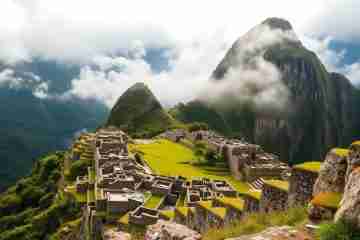
Start your journey along the ancient Inca path to Machu Picchu, a New Seven Wonder of the World. The Inca Trail is famous for its stunning views and rich history. It’s perfect for all hikers, with tours lasting from 2 to 7 days.
To hike the Inca Trail, you must get a permit. These are only available through approved tour companies. The 4-day trek is the most sought-after, covering 39 kilometers of Inca-made paths. You’ll see amazing sights and finally see Machu Picchu from the Sun Gate.
Key Takeaways
- The Inca Trail is a renowned hiking route leading to the iconic Machu Picchu in Peru.
- Trekking options range from 2-day to 7-day tours, catering to hikers of various skill levels.
- Permits are required and can only be obtained through licensed tour operators, with limited availability.
- The classic 4-day Inca Trail trek is the most popular option, covering 39 kilometers of historic Inca trails.
- The trek offers a unique opportunity to explore ancient Inca ruins and witness the breathtaking first view of Machu Picchu from the Sun Gate.
Understanding the Inca Trail Experience
The Inca Trail is a journey through ancient ruins, high-altitude treks, and stunning landscapes. It’s part of the Qhapac Ñan, a vast network of Inca roads. This trail lets visitors experience the history and culture of the Inca civilization.
The Historical Significance of Qhapac Ñan
The Qhapac Ñan, or Great Inca Road, spanned from Colombia to Chile. It was key for the Inca’s control and for moving goods and people. This network was vital for their empire.
Different Trail Options and Durations
- The Classic 4-day Inca Trail: The most popular hike, covering 33.7 miles (54.3 km).
- The 2-day Inca Trail: A shorter version, perfect for those with less time.
- The 6-day Salkantay Inca Trail Trek: Combines the Inca Trail with Salkantay Mountain.
Required Permits and Regulations
Only 500 permits are issued daily (200 for tourists, 300 for staff). Due to high demand, book your trek 6-7 months in advance.
| Inca Trail Trek Options | Duration | Distance |
|---|---|---|
| Classic 4-day Inca Trail | 4 days, 3 nights | 26 miles / 42 km |
| Traditional 4-day Inca Trail | 4 days, 3 nights | 33.7 miles / 54.3 km |
| Salkantay 6-day Inca Trail Trek | 6 days, 5 nights | N/A |
“The Inca Trail is a unique and transformative experience that allows you to walk in the footsteps of the Inca and connect with the rich cultural heritage of Peru.”
Best Time to Trek the Inca Trail
Exploring the Inca Trail to Machu Picchu is an adventure. The timing of your trek greatly affects your experience. Peru’s andes mountain trekking has different seasons, each with its own perks and challenges. Let’s explore the best time for this amazing journey through the peru hiking seasons.
The dry season, from April to October, is the best time for trekking. The weather is usually dry and sunny, making hiking more comfortable. May, June, and July are especially good because they have little rain, but can be chilly.
The rainy season, from November to March, brings a lush landscape. But, the trails can be slippery. February is the wettest month, and the trail is often closed for maintenance and safety.
To summarize the best times to trek the Inca Trail:
- May to August: Bright, sunshiny days with minimal rain, considered the prime trekking season.
- April, September, and October: Shoulder months with fewer crowds and mostly dry conditions.
- Avoid February: The trail is closed for maintenance during the wettest month.
Inca Trail permits are very popular and often sell out early, especially in peak season. Booking your permits 6-8 months ahead is key for a smooth trek.
The andes mountain trekking and peru hiking seasons offer many options for travelers. By considering the weather, trail conditions, and permit availability, you can plan the perfect Inca Trail trek. This will match your preferences and travel plans.
Essential Preparation and Planning Guide
Starting the Inca Trail trek needs careful planning and preparation. The trail is challenging, requiring good physical shape. It’s also important to get used to the high altitude, as it goes over 13,000 feet.
Bringing the right gear for different weather and heights is key. This ensures a safe and enjoyable trip.
Physical Conditioning Requirements
The Inca Trail is 26 miles long, spread over four days. It involves daily climbs of up to 1,200 meters. To get ready, start training gradually.
Include exercises that improve strength, balance, and mobility. This helps build endurance and lowers injury risk. Stair training, increasing steps from 40 to 70, is also helpful.
Altitude Acclimatization Tips
The high altitude of the Inca Trail can be tough. To adjust, spend a few days in Ollantaytambo (9,160 feet) before starting. This is better than starting in Cusco (11,152 feet).
Acclimating slowly helps your body adjust to the lower oxygen levels. This reduces the chance of altitude sickness.
Packing Essentials for the Trek
Choosing the right gear is vital for the Inca Trail. Pack clothes for different weather, like warm jackets and rain gear. Also, bring breathable base layers.
Sturdy hiking boots, a good backpack, and sun protection are must-haves. Don’t forget personal items like a water filter, snacks, and any needed medicines.
Good preparation and planning make the Inca Trail trek better. They help ensure a successful and unforgettable journey.
Inca Trail Trekking: Route Overview and Highlights
The Inca Trail itinerary is a journey through the Andes. It shows off the ruins and landscapes that have amazed people for centuries. This famous hike is 39 kilometers long and takes 4 days to complete. It’s the best part of the Machu Picchu trek highlights.
The trek starts in Cusco, at 3,400 meters high. It goes up to Dead Woman’s Pass, over 4,200 meters. This part on the second day is tough. But the views are worth it.
- Walk on original Inca trails and see their amazing work.
- See unique plants and animals, like over 250 orchid species in Machu Picchu.
- Find spots with stunning views of snow-capped mountains, like Salkantay at 6,271 meters.
The Inca Trail itinerary is from moderate to high in difficulty. But the feeling of achievement and the Machu Picchu trek highlights make it unforgettable. It’s a great challenge for those who are ready.
“The Inca Trail trek is a transformative journey that connects you to the rich history and stunning natural beauty of the Andes.” – Experienced Inca Trail Guide

Archaeological Sites Along the Trail
The Inca Trail is filled with ancient ruins and archaeological sites. These sites show the history and engineering skills of the Inca people. Hikers see well-preserved structures that highlight the Inca’s ingenuity and sophistication.
Llactapata and Runkurakay
Llactapata is one of the first sites on the Inca Trail, at 9,300 ft / 2,840 m. It’s a big ruin that hikers on the 5-day trek can explore. Runkurakay, at 12,100 ft / 3,700 m, is another site. It’s known for its defensive structures and is best visited in the afternoon to avoid crowds.
Sayacmarca and Phuyupatamarca
As hikers go up, they see Sayacmarca at 11,800 ft / 3,600 m. This site shows the Inca’s skill in stone masonry and their ability to work with the Andean terrain. Phuyupatamarca, also at 11,800 ft / 3,600 m, is known for its misty, magical feel, especially in the rainy season.
Wiñayhuayna: The Final Wonder
Before reaching Machu Picchu, hikers visit Wiñayhuayna at 8,500 ft / 2,600 m. This site is as beautiful as Machu Picchu, with terraced gardens and impressive stone structures. It’s a great introduction to the grandeur of Machu Picchu.
The Inca Trail’s sites give hikers a deep dive into Inca history and culture. It’s an experience that will stay with you forever as you journey to Machu Picchu.
Camping and Accommodation Experience
The inca trail camping experience is a key part of the journey to Machu Picchu. Trekkers stay at well-equipped campsites along the trail. These camps offer the comforts needed for a memorable adventure in the Andes.
The main campsites are Huayllabamba, Pacaymayo, and Wiñayhuayna (or Phuyupatamarca). Tour agencies set these up to meet trekking accommodation needs. They provide cozy tents, hot meals, and basic amenities. Staying in nature adds to the Inca Trail experience.
- Inca Trail permits for 2025 will be released the first week of November 2024.
- The 2-Day Short Inca Trail Trek with Hotel option lasts for 2 days and 1 night.
- The 2-Day Short Inca Trail Trek with Camping is a 2D/1N adventure.
- The Short Inca Trail trek with Camping 2D/1N offers hot showers and fresh meals at the campsite.
Whether you pick the hotel or camping option, the Inca Trail accommodations are special. They let you dive into the stunning landscapes and rich culture of the Andes. With expert guides, all the necessary permits, and top-notch gear, trekkers can make unforgettable memories on their way to Machu Picchu.

“The Inca Trail camping experience was the highlight of our journey to Machu Picchu. Waking up surrounded by the Andes’ majesty was truly awe-inspiring.”
Flora, Fauna, and Natural Landscapes
Trekking the Andes mountain range along the Inca Trail is a unique chance to see the rich andes mountain wildlife and peruvian flora and fauna. This diverse ecosystem offers stunning natural wonders. From high-altitude landscapes to lush tropical forests, the trail is breathtaking.
Native Wildlife Encounters
As you trek the Inca Trail, you might see remarkable wildlife. There are 13 fish, 12 amphibians, 22 reptiles, 423 birds, and 53 mammals along the way. In Machu Picchu, you can see llamas, giant hummingbirds, and sometimes the Andean bear.
The Andean bear is the only bear in South America. These herbivorous creatures live in humid forests. You might also see Andean cougars, Andean condors, taruca, and river otters along the trail.
Unique Andean Vegetation
The Inca Trail has over 50 tree species per hectare and nearly 200 orchid species. You can see Queuña trees, bromeliads, and the Puya Raimondi with its tall flower spikes.
The trail is full of diverse plants, like cedars, molles, and Andean ferns. It supports a wide range of flora, from high-altitude queñuales to tropical floripondios.
It’s crucial to protect this andes mountain wildlife and peruvian flora and fauna. Conservation efforts, like protected areas and research, help keep this ecosystem alive.
The Sun Gate and First Views of Machu Picchu
The Intipunku (Sun Gate) is a key moment for intipunku machu picchu and sun gate trek adventurers. It’s the first view of Machu Picchu for those who trek here. Located at 2,720 meters (8,924 feet), it offers a breathtaking view of the ancient city.
The hike to the Sun Gate starts at Machu Picchu and goes up 290 meters (951 feet). The trail is not too steep, with a 35-degree angle. At the top, you see Machu Picchu, a sight many call the best part of the sun gate trek.
- Altitude of the Sun Gate: 2,720 meters (8,924 feet)
- Altitude Gain during the hike: 290 meters (951 feet)
- Location of the Sun Gate: Upper southeast part of Machu Picchu
- Typical time to pass through the Sun Gate for Inca Trail hikers: Early morning on the last hiking day
- Hike description: Gradual trail with a maximum angle of 35 degrees, steepening towards the last 15 minutes
- Maximum time for the hike downhill from the Sun Gate: 45 minutes
To see the Sun Gate and Machu Picchu, you need a Circuit 1C ticket. You also need a Circuit 2 ticket to explore more of the Inca city. The early morning is the best time to visit the Sun Gate, with fewer people around.
“Seeing Machu Picchu from the Sun Gate is a moment I will never forget. It’s a breathtaking and emotionally moving experience that truly captures the essence of the Inca civilization.”
Professional Guide Services and Porter Support
The Inca Trail experience is made better by the help of professional guides and porters. They are key to a safe and fun trek. Guides share history and culture, giving a deeper look into the trail’s past.
They also know how to navigate and keep everyone safe. This lets trekkers enjoy the journey without worry.
Porters are also very important. They carry all the gear, so trekkers can just enjoy the hike. Many people thank them for their hard work.
Porters know the trail well and handle all kinds of weather. They are a big part of the team.
Choosing a good Inca Trail operator, like TreXperience, means you get a great team. They make sure everyone has a good time. Their knowledge and care for safety and the community make the trip unforgettable.