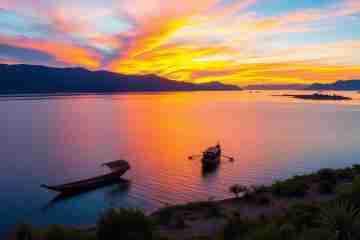
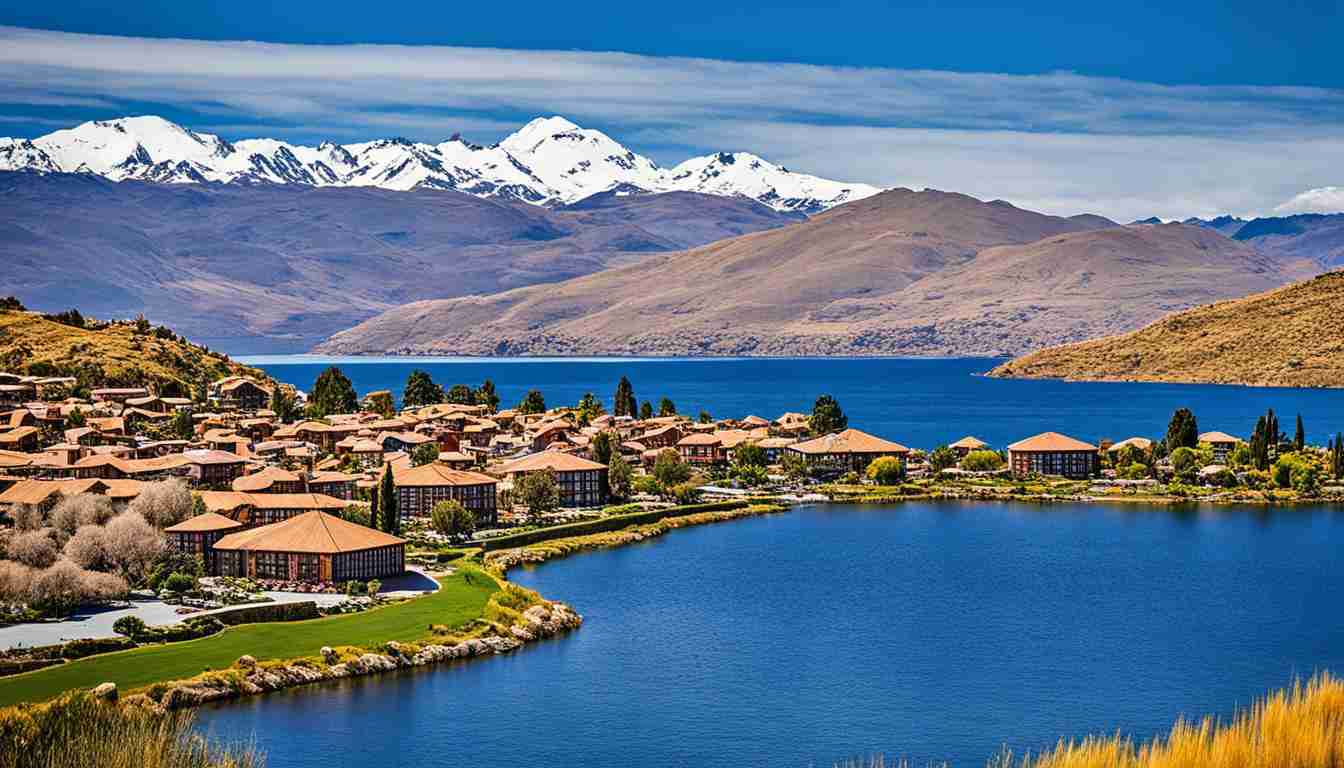
In the Andes Mountains, Lake Titicaca is a stunning sight. It’s one of the highest lakes you can sail on in the world. It’s high up at 3,812 meters (12,507 feet) above sea level.
This huge lake is on the border of Peru and Bolivia. It’s a special place for those who love to see beautiful views. The Altiplano region is known for its amazing landscapes.
Key Takeaways








- Lake Titicaca is one of the highest navigable lakes in the world, situated at an elevation of 3,812 meters (12,507 feet) above sea level.
- It is the largest lake in South America, covering an area of over 3,200 square miles (8,300 square kilometers).
- The lake is shared between Peru (60%) and Bolivia (40%), offering visitors the chance to explore the cultural richness of both countries.
- Titicaca’s high-altitude location in the Andes Mountains provides a unique and breathtaking natural landscape.
- The lake is home to a diverse range of wildlife, including the critically endangered Titicaca water frog and the blue-headed parrot.
Location and Basics
The Lake Titicaca is in the Andes mountains of South America. It is on the border of Peru and Bolivia. This lake is high up, in the Altiplano basin. Its geographical coordinates are 15°49’30″S 69°19’30″W.
About 60% of the lake is in the Puno Region of Peru. The other 40% is in the Bolivian La Paz Department. This makes it a transboundary lake that links the two countries.
Geographical Coordinates
Lake Titicaca’s coordinates put it in the Andes mountains. This makes it a key part of South America’s landscape. It shows off the area’s breathtaking geographical features.
“Lake Titicaca is a true wonder of South America, with its stunning location straddling the border between Peru and Bolivia.”
titicaca elevation
Lake Titicaca sits high in the Andes Mountains, far from the ordinary. It’s the highest navigable lake in the world, with a surface at 3,812 meters (12,507 feet). This makes it a standout among lakes globally.
While some lakes are higher, like Ojos del Salado’s crater lake, Lake Titicaca is the highest large lake in the world. Its high altitude supports diverse aquatic life and is crucial for local communities.
The Andes Mountains, towering above the lake, add to its beauty. Visitors can enjoy the stunning views and learn about the area’s rich culture.
| Statistic | Value |
|---|---|
| Surface Elevation | 3,812 meters (12,507 feet) |
| Surface Area | 8,372 km² (3,232 sq mi) |
| Salinity | Approximately 5.5 parts per 1,000 |
| Water Temperature | Surface: 14°C (56°F), Bottom: 11°C (52°F) |
| Climate | Alpine, with cold temperatures year-round |
The high altitude of Lake Titicaca brings both challenges and benefits. Visitors must be aware of the risk of altitude sickness. Yet, the lake’s unique setting has nurtured a rich culture and diverse ecosystem, drawing in travelers worldwide.
Size and Depth
Lake Titicaca is the largest freshwater lake in South America. It sits at 12,500 feet high in the Andes Mountains. This lake stretches for 190 km in a northwest-to-southeast direction. It reaches a maximum width of 80 km.
Surface Area and Length
Lake Titicaca is a massive sight. It covers 8,372 km2, making it one of the biggest freshwater lakes globally. Its length and width add to its grand scale.
Depth
Lake Titicaca is also deep. The average depth is 107 m, but Lago Grande is deeper, with a mean depth of 135 m. It reaches a maximum depth of 284 m. Wiñaymarka is shallower, with an average depth of 9 m and a maximum of 40 m. These depths show the lake’s vastness.
| Measurement | Value |
|---|---|
| Surface Area | 8,372 km2 (3,232 sq mi) |
| Length | 190 km (118 mi) |
| Width | 80 km (50 mi) |
| Average Depth | 107 m (351 ft) |
| Maximum Depth | 284 m (932 ft) |
Ecology and Wildlife
Lake Titicaca sits high in the Andes, a true natural wonder. It’s home to over 530 aquatic species. This lake is a hotspot for unique plants and animals, like the endangered Titicaca water frog and the flightless Titicaca grebe.
The lake’s ecosystem is linked to the Andean highlands. Its high altitude and unique conditions support a rich biodiversity. You’ll find many Orestias fish, freshwater snails, and catfish here.
Lake Titicaca is vital for water birds. It was named a Ramsar Wetland of International Importance in 1998. The lake and its wetlands are key for many birds, including flamingos.
| Aquatic Species | Endemism | Conservation Status |
|---|---|---|
| Titicaca Water Frog | Endemic | Critically Endangered |
| Titicaca Grebe | Endemic | Endangered |
| Orestias Fish | Endemic | Vulnerable to Endangered |
| Astroblepus Fish | Endemic | Least Concern to Endangered |
| Trichomycterus Fish | Endemic | Least Concern to Endangered |
The titicaca ecology is under threat from pollution, habitat loss, and invasive species. Saving the titicaca wildlife and its ecosystem is key to preserving this unique Andean lake.

Cultural Significance
Lake Titicaca has been very important to the Andean people for thousands of years. It is thought to be where the Inca civilization began. Many important Inca ruins and sacred places are found along its shores and islands.
People have lived in the Titicaca area for over 10,000 years. Different Andean pre-Hispanic societies and ethnic groups have shaped the region. They left their mark on the land.
The lake and its islands are full of history and culture. You can see ancient farming methods, textiles, traditions, and beliefs. The Uros Floating Islands and the textiles of Taquile Island show the creativity of the Andean people.
Sillustani is a key archaeological site with funerary towers called chullpas. The ruins on Isla del Sol and Isla de la Luna also show the spiritual beliefs of the Inca civilization and earlier societies.
Today, Lake Titicaca is still celebrated for its culture. It is important to the local communities. Visitors can learn about the Andean pre-Hispanic societies and their traditions.
“Lake Titicaca is not just a body of water; it is a living entity that has nurtured and inspired the Andean peoples for millennia. Its cultural significance is woven into the very fabric of the region’s identity.”
Islands and Attractions
Lake Titicaca, a high-altitude lake shared by Peru and Bolivia, is full of islands with unique cultural and natural wonders. It’s home to the famous Isla del Sol, the “Island of the Sun,” where the Inca Empire began. You’ll also find the peaceful Isla Amantani, known for its vibrant textiles.
Notable Islands
The Uros Floating Islands are a highlight, built by the Uru people from reeds. These islands, near Puno, Peru, show a life that has lasted for centuries. Visitors can see how the Uru people live.
Further along, Isla de la Luna, the “Island of the Moon,” has ancient Inca ruins and a women’s temple. Isla Taquile is famous for its textiles and traditional communities. It’s a place where you can really feel the Andean culture.
Isla Amantani is perfect for those looking for peace. It has beautiful farms and friendly locals. With about 4,000 people, it’s a chance to experience Lake Titicaca’s natural beauty away from the hustle and bustle.

“Exploring the islands of Lake Titicaca is like stepping into the heart of an ancient civilization, where the past and present coexist in a captivating dance.”
Threats and Conservation
Lake Titicaca, located between Peru and Bolivia, is facing many threats. These threats are putting its ecological and cultural value at risk. The main worry is the lake’s water level going down. This is happening because of less rain and melting glaciers.
Another big problem is pollution in the water. As cities grow around the lake, there’s no good way to handle waste and sewage. The Global Nature Fund says this pollution is harming the lake’s unique plants and animals. This includes the famous titicaca water frog.
In 2012, the Global Nature Fund named Lake Titicaca the “Threatened Lake of the Year.” This brought attention to the need for more conservation. Now, the titicaca water frog is listed as Critically Endangered by the IUCN. This shows how serious the threats are.
- The titicaca water frog is key to Lake Titicaca’s ecosystem. Its decline shows the lake is getting worse.
- Urban growth and farming are destroying its home. Plus, pollutants are making the lake unhealthy for the frog.
- Climate change is also a big problem. It changes the water levels and quality, threatening the titicaca water frog.
There are efforts to save the lake and its frog. These include research, protected areas, and working together between Peru and Bolivia. The Telmatobius Captive Breeding Program in Lima is trying to save the titicaca water frog.
Teaching people and getting the community involved is also important. By spreading the word and encouraging change, we can help protect Lake Titicaca and its unique life, including the titicaca water frog.
Conclusion
Lake Titicaca is a high-altitude wonder in the Andes mountains between Peru and Bolivia. It stands at 3,812 meters (12,507 feet) above sea level. This makes it the highest navigable lake in the world and the biggest freshwater lake in South America.
The lake is surrounded by natural beauty and is home to many unique species and ecosystems. It also has a rich cultural heritage. The ancient Inca ruins and traditional communities by the lake show its historical and cultural importance.
Lake Titicaca is known for its vast waters and unique wildlife, like the Andean flamingos and the giant Titicaca frog. These features make it a natural wonder that draws visitors from all over.
Even with environmental challenges, Lake Titicaca remains a special place. It offers a chance to see a unique high-altitude lake. By protecting the lake and its ecosystems, we can keep its magic alive for future generations.